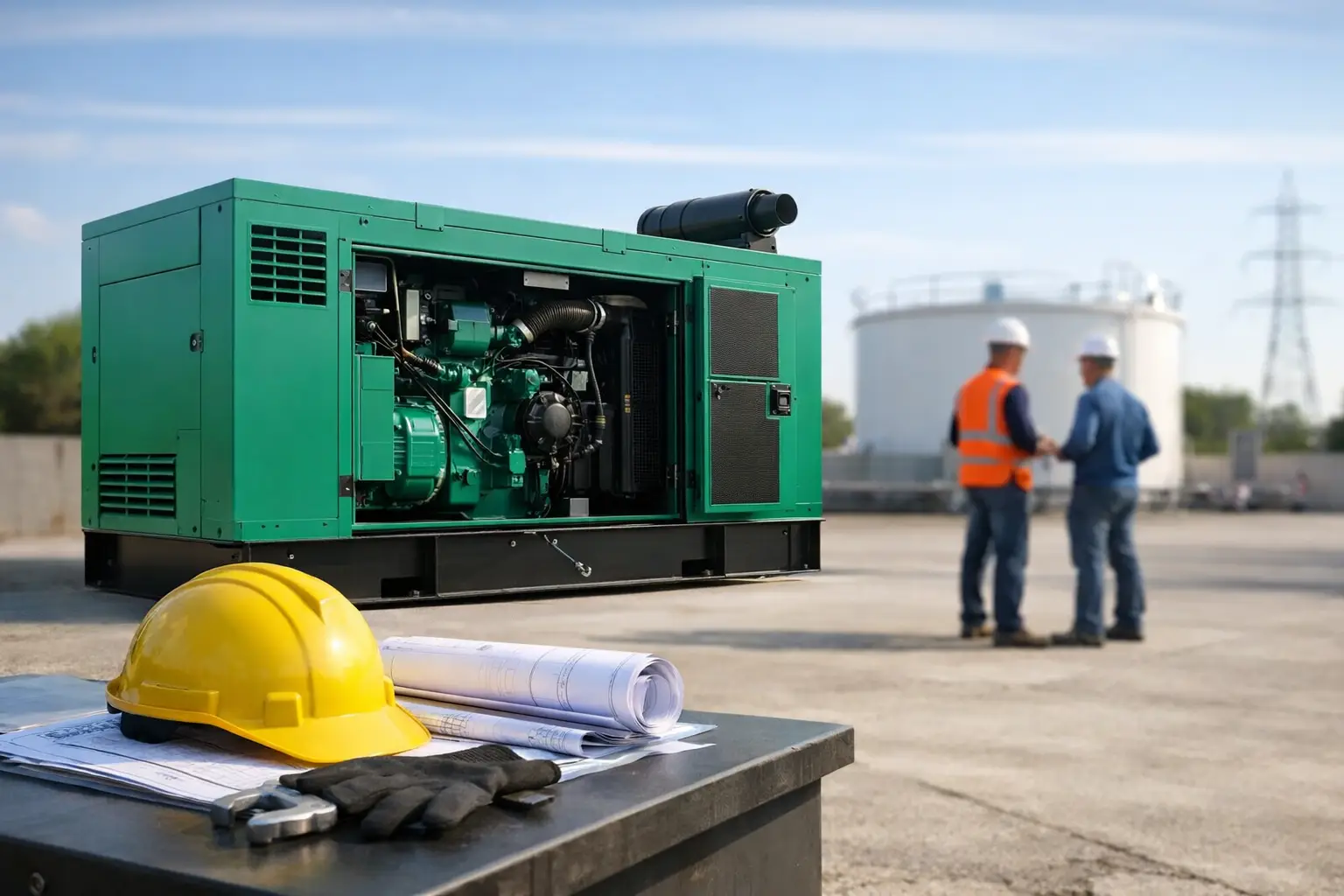
100kVA Diesel Generator Buying Guide
A 100kVA diesel generator sits in a critical part of the market. It is large enough to support substantial commercial and industrial loads, but still compact enough for many site, plant room, and temporary power applications where space, access, and installation time matter. For buyers who need dependable backup power or a practical prime power unit, this size often delivers the right balance between capacity, footprint, and cost.
That balance is exactly why 100kVA sets are widely specified across construction, manufacturing, logistics, healthcare support buildings, telecoms infrastructure, commercial premises, and agricultural operations. But choosing the right unit is not just a question of headline kVA. The correct specification depends on how the generator will be used, what it needs to start, where it will be installed, and how much operational risk the site can tolerate.
When a 100kVA diesel generator is the right fit
In simple terms, a 100kVA diesel generator is typically considered where the site load sits beyond the range of smaller commercial sets, but does not justify a larger and more expensive industrial package. That might mean supporting lighting, HVAC, pumps, compressors, IT infrastructure, refrigeration, welfare buildings, workshops, or mixed building services on a standby basis.
For some sites, 100kVA is ideal as an emergency backup generator that only runs during mains failure. For others, it serves as a prime power source on remote locations where grid access is limited or unavailable. Those two use cases are not the same, and they should not be treated as interchangeable when reviewing specifications.
A standby application generally allows the set to operate only during outages, often with variable annual running hours. A prime power application assumes longer and more regular operation, often with fluctuating loads. The duty rating, engine performance, alternator sizing, and service planning all need to reflect that difference.
Standby vs prime power at 100kVA
This is one of the first points procurement teams and project engineers should clarify. A generator advertised at 100kVA may refer to standby power, while the prime power rating could be lower. That is normal across the industry. If a site requires continuous or long-duration operation, the prime rating is usually the more relevant figure.
Where buyers get into difficulty is assuming that a 100kVA nameplate means 100kVA is available in every operating condition. It is not. Ambient temperature, altitude, load profile, motor starting demand, and derating factors all influence real-world performance. If the application includes large inductive loads such as pumps, fans, or compressors, the starting current may place more stress on the generator than the running load suggests.
This is why load assessment matters. A set that appears correctly sized on paper can still struggle if the site has poor sequencing, high inrush currents, or a requirement to restore all services at once after a power failure.
What to check before specifying a 100kVA diesel generator
The most useful buying process starts with the load, not the product. Buyers should establish the actual connected load, the essential load, and the load that must start first. In many cases, not every circuit needs generator backup. Prioritising critical services can reduce overspend and improve operational efficiency.
Voltage and phase are equally important. Most units at this size are specified as 3 phase generators for commercial and industrial duty, but that does not remove the need to confirm site distribution, load balance, and any single-phase circuits that need support. The wrong configuration can create avoidable commissioning issues.
The physical format also matters. A silent generator is often preferred where the unit will operate close to occupied buildings, public-facing sites, hospitals, schools, commercial estates, or residential boundaries. An open generator may suit plant room installation or controlled industrial environments where acoustic containment is handled separately. Neither option is universally better. It depends on the site, planning conditions, and access constraints.
Fuel tank arrangement should also be reviewed early. Runtime expectations vary sharply by application. Some standby sites only need a few hours of autonomy before mains is likely to return. Other facilities require extended operation because the consequence of outage is too severe to accept fuel dependency without additional reserve.
Performance, reliability, and engine quality
At 100kVA, engine quality is not a minor detail. Buyers in critical sectors are not simply purchasing a machine that can produce electricity. They are purchasing confidence that the unit will start, accept load, and continue running when the site needs it most.
That is why recognised engine platforms remain central to procurement decisions. Cummins-powered sets are frequently specified because buyers want a proven engine, dependable parts support, and a clear service pathway. Reliability is built not only on the engine itself, but also on the alternator, controller, enclosure, cooling package, and how the full generator set is engineered.
A low purchase price can look attractive at the enquiry stage, but downtime costs quickly outweigh any saving if the equipment is poorly supported or incorrectly matched to the application. This is especially true for hospitals, data-dependent facilities, food operations, utilities, and continuous production sites where failure has direct operational and financial consequences.
Noise, footprint, and site conditions
A 100kVA diesel generator is a practical mid-range size, but it still needs careful planning around installation. Access for offloading, final positioning, ventilation, exhaust routing, and maintenance clearance all need to be considered before delivery. Site teams often focus on the generator itself, while the avoidable delays come from access width, crane planning, or insufficient service space around the enclosure.
Noise should never be treated as an afterthought. Even where a generator is only intended for emergency use, local restrictions and neighbouring occupiers may still shape the specification. Acoustic canopies help significantly, but the expected run profile and site sensitivity should guide the final noise requirement.
Environmental conditions also affect performance. High ambient temperatures can reduce effective output if the set is not appropriately rated. Dusty construction environments, exposed coastal locations, and remote utility sites all place different demands on filtration, corrosion resistance, and maintenance intervals.
Running costs and service planning
A 100kVA diesel generator is often chosen because it offers strong capacity without stepping into the higher capital and fuel costs associated with larger sets. Even so, running cost should be reviewed realistically. Fuel consumption depends on load factor, operating hours, and duty cycle. A generator running lightly loaded for long periods may be less efficient than expected and can develop operational issues if the application is poorly managed.
Service access, consumables, and planned maintenance should be part of the buying decision from the outset. If the generator is backing up a site where power continuity is non-negotiable, maintenance should be treated as part of the asset, not an optional extra.
This is where stock availability and supplier responsiveness matter. If a project has a fixed mobilisation date or a facility needs fast replacement capacity, long lead times can be a commercial problem. Buyers often need clarity on what is in stock, what can be delivered quickly in the UK, and what support is available for export or specialist project requirements. For that reason, working with a specialist supplier such as Global Generators can shorten the route from specification to delivery.
Common mistakes when buying at this power level
The first mistake is oversimplifying the load. A 100kVA set may be right for the average demand, but not for the starting profile or future load growth. The second is treating standby and prime ratings as if they are the same. They are not. The third is choosing on price alone without considering engine quality, parts support, and the cost of failure.
Another common issue is underestimating installation requirements. Buyers may secure the right machine but overlook ventilation, exhaust design, fuel compliance, cable routing, or access for servicing. These points are not peripheral. They affect whether the generator can perform properly once on site.
Choosing with the application in mind
For a facilities manager protecting essential building services, the right 100kVA diesel generator is the one that starts reliably, integrates cleanly with the changeover system, and carries the priority load without drama. For a contractor on a temporary site, the priority may be mobility, runtime, and simple operation. For industrial users, the focus may shift towards motor starting, sustained load acceptance, and serviceability under demanding conditions.
That is why there is no single best 100kVA generator in the abstract. There is only the best fit for the duty. The most effective procurement decisions come from matching rating, enclosure type, engine platform, control functionality, and site conditions to the real operating requirement.
If you are specifying at this level, take the time to define the load properly and challenge any assumptions around duty, runtime, and installation. A well-matched generator earns its value in the moment the mains fails and the operation carries on as planned.