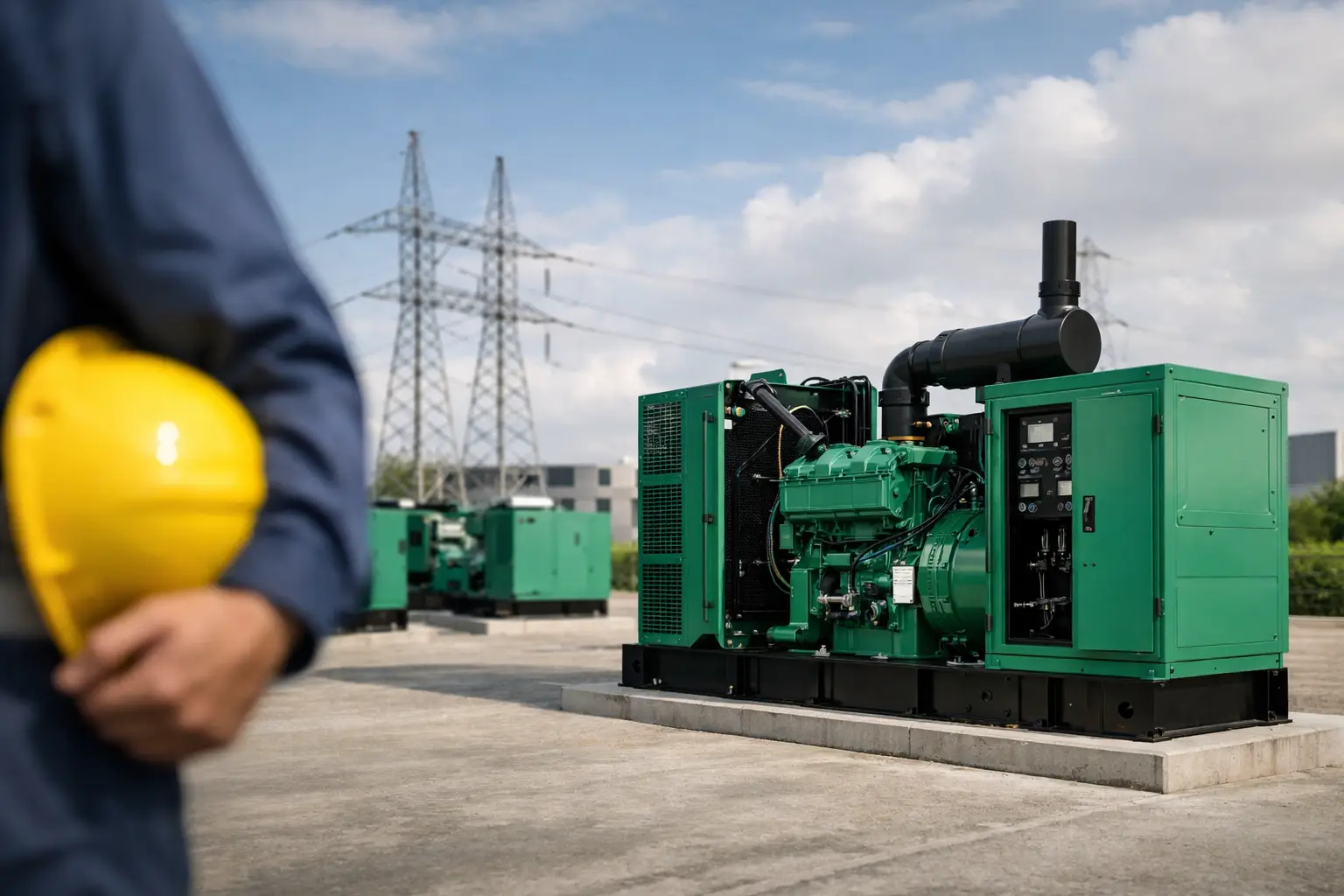
Choosing the Right Three Phase Generator
A three-phase generator is rarely a discretionary purchase. In most cases, it is specified because a site has equipment, distribution, or operational risk that single phase power cannot support efficiently. If the load includes motors, pumps, compressors, HVAC plant, production machinery, lifts, or large commercial building services, three-phase power is usually the correct starting point.
That matters because generator selection errors are expensive. Oversize the set and you carry unnecessary capital cost, poor load factor and inefficient fuel use. Undersize it and the result can be unstable voltage, nuisance tripping, motor starting problems, or outright failure during a mains outage. For buyers responsible for uptime, the right decision comes from matching the generator to the actual duty, not simply choosing the next size up.
What a three-phase generator is designed to do
A three-phase generator produces electrical output across three alternating current phases, typically for 400V applications in the UK. Compared with single phase supply, it is better suited to higher loads and equipment that demands smoother power delivery. Industrial and commercial sites use it because it supports balanced distribution and more efficient operation of heavy electrical plant.
In practical terms, this is the standard format for many critical installations. Manufacturing facilities, warehouses, hospitals, data and telecoms sites, water infrastructure, construction compounds and large commercial buildings commonly require three-phase backup or prime power because the installed load is already built around three phase distribution.
That does not mean every site needs the same machine. A standby set supporting emergency lighting and life safety systems has very different operating demands from a prime power unit feeding a remote works site for extended daily running. The correct specification depends on how the generator will be used, how often it will run, and what it needs to start.
Standby or prime power changes the specification
The first distinction to make is duty rating. A standby three-phase generator is intended to run during utility failure. A prime power generator is built for regular or continuous operation where the mains is absent, unreliable, or only part of the site strategy.
This is not just a label change. Prime-rated operation affects engine loading, service intervals, fuel storage planning and long-term running cost. If a set is likely to operate for sustained periods, it needs to be selected on that basis from the outset. Choosing a standby-rated machine for regular production duty usually proves false economy.
For procurement teams, this is one of the most common points where a project can drift off-spec. The generator may appear suitable on headline kVA, but the true operating profile tells a different story. A serious supplier will always ask whether the application is standby, prime, or a hybrid duty with load variation across the day.
Sizing a three-phase generator properly
Correct sizing starts with the site load, but not just the total connected load. The more relevant figure is the realistic running load, the starting characteristics of individual items, and whether those loads come on all at once or in sequence.
Large motor loads are often the deciding factor. Pumps, fans, compressors and refrigeration plant can draw a high inrush current at start-up. If the generator is not sized to absorb that transient demand, voltage dip can become severe enough to trip controls or prevent the motor from accelerating cleanly. That is why a site with a moderate running load can still require a substantially larger set.
Load composition matters as much as load volume. Resistive loads such as heating are relatively straightforward. Non-linear loads, variable speed drives, UPS systems and sensitive electronics require more care. Harmonic distortion, poor power factor and step loading can all affect performance. On mixed-use sites, the generator must support both the mechanical plant and the control infrastructure that keeps the operation stable.
A useful buying approach is to work from these questions: what must run, what can be shed, what starts first, and what happens if the generator only has seconds to pick up the load. That usually produces a much more accurate sizing basis than relying on a broad estimate from the building incomer alone.
Why kVA is only part of the picture
Buyers often begin with a target kVA, which is sensible, but kVA on its own does not define suitability. You also need to consider power factor, transient response, alternator performance, governing quality and site altitude or ambient conditions if they are outside standard assumptions.
A generator operating in a plant room with restricted airflow, for example, may require derating. The same applies to hot climates, high-altitude installations or applications with sustained low-speed manoeuvring loads and repeated motor starts. These details can shift the practical output below the nominal rating on the data sheet.
For this reason, specification should be read in context. Engine brand, alternator quality, control system capability and enclosure design all influence real-world performance. Buyers comparing units purely on headline kVA and price often overlook the difference between a generator that meets the number and one that holds the load reliably when the mains fails without warning.
Open or silent enclosure
The choice between an open set and a silent generator is usually driven by the installation environment. An open set is often suitable for plant rooms, acoustic housings, or controlled industrial spaces where noise containment is handled separately. It can also simplify service access in some engineered installations.
A silent generator is generally the better option for outdoor deployment, mixed-use commercial sites, residential adjacency, or projects where planning and noise restrictions apply. The enclosure adds weather protection and acoustic attenuation, but it also changes footprint, access requirements and transport considerations.
Neither option is universally better. It depends on the site, the duty, and the service strategy. What matters is that the enclosure arrangement supports cooling airflow, maintenance access and safe operation over the intended lifecycle.
Fuel consumption, autonomy and operational cost
For standby applications, fuel planning is often treated as a secondary issue until an outage lasts longer than expected. For prime power, it is central to the business case from day one. In both cases, runtime at expected load matters more than headline tank size.
A properly specified three-phase generator should be assessed against actual site autonomy requirements. If a facility needs eight, twelve or twenty-four hours of independent operation, the fuel system has to support that without creating avoidable refuelling risk. On remote or high-security sites, this can be as important as the generator rating itself.
Fuel efficiency also improves when the set operates within a sensible load band. A generator that spends most of its life lightly loaded tends to be less efficient and may suffer from wet stacking in diesel applications. A unit selected too tightly, on the other hand, can run under chronic stress. The best outcome is usually a set sized around realistic operating load with appropriate allowance for starting and future expansion.
Installation details that affect reliability
A generator can be technically well chosen and still underperform because of poor installation design. Cable sizing, earthing, changeover arrangement, ventilation, exhaust routing and fuel system layout all affect reliability. So does the control philosophy, especially where automatic mains failure operation is required.
For mission-critical sites, the transfer arrangement deserves close attention. The set must not only start, it must also assume load in a controlled way and communicate clearly with site operators. Alarm visibility, remote monitoring and service access are not optional extras when downtime carries financial or safety consequences.
This is where a specification-led procurement process pays off. It reduces the chance of buying a generator that looks right in inventory but does not integrate cleanly with the site infrastructure.
What serious buyers should ask before ordering
Before committing to a three-phase generator, the critical questions are straightforward. Is the application standby or prime. What are the running and starting loads. What voltage and phase arrangement does the site require. Does the installation need an open or silent set. What runtime is expected. Are there any space, access, acoustic or environmental constraints.
It is also worth asking how quickly the unit can be delivered, whether the supplier carries stock in the required power range, and whether the specification is based on known engine and alternator packages with established service support. Availability matters when a project deadline or resilience gap leaves little margin.
For buyers working to programme, stockholding and response time are often decisive. A strong product range is useful only if the required configuration is available when the project needs it.
A three-phase generator should be selected as a working asset, not a box-ticking purchase. When the load profile, duty rating, enclosure type and site conditions are aligned, the result is dependable power under pressure. If the requirement is urgent or the application is complex, a supplier such as Global Generators can help narrow the specification quickly and keep the purchase focused on uptime rather than guesswork.
The right generator is the one that carries the site when conditions are at their worst, not the one that merely looks acceptable on paper.